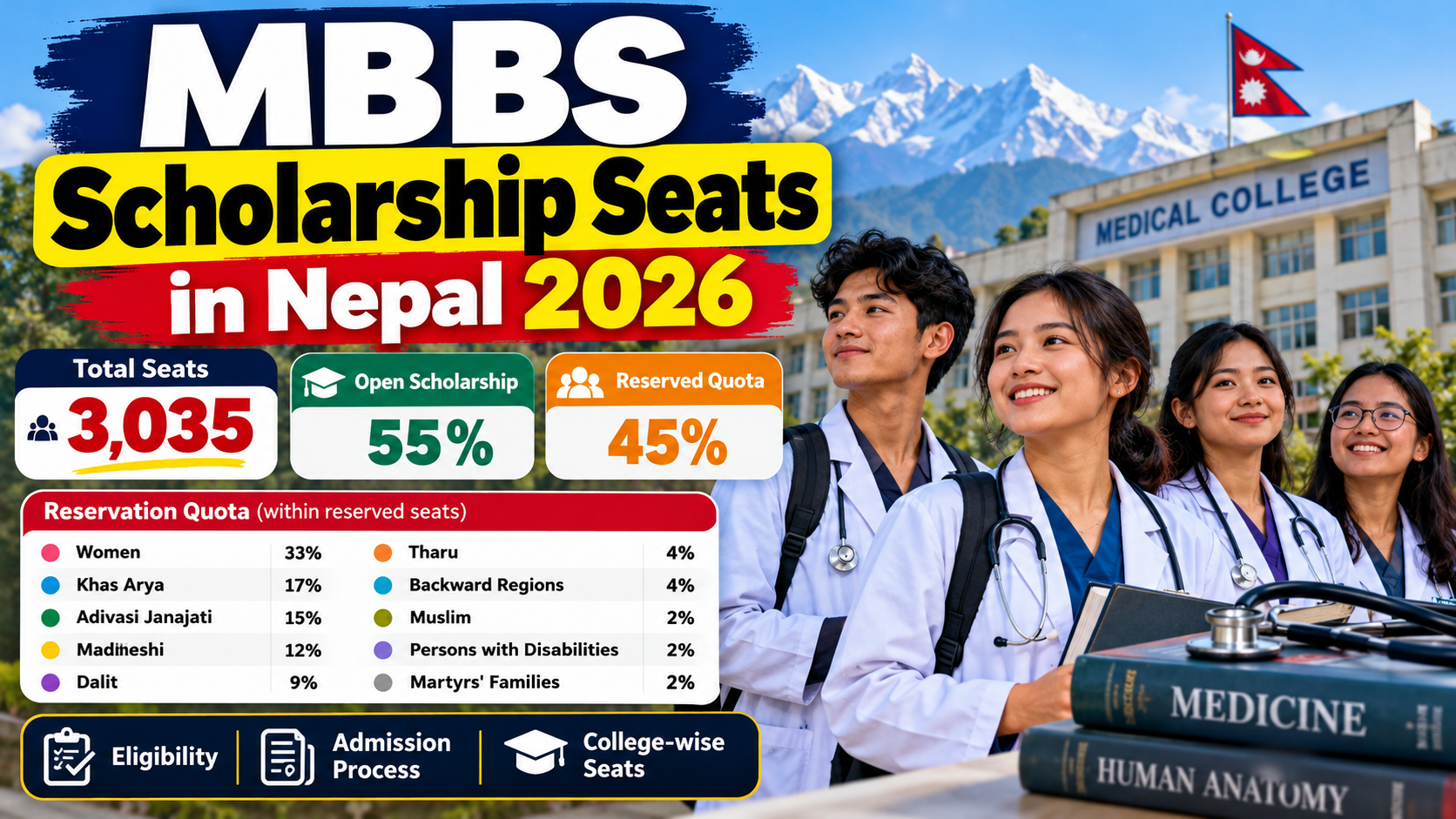
Becoming a doctor is a dream shared by thousands of Nepali students. But with expensive medical education and limited scholarship seats, understanding the admission system can make a big difference.
The Medical Education Commission (MEC) manages MBBS admission through the Common Entrance Examination (MECEE-BL), merit ranking, reservation quotas, and college matching.
Here is a concise guide to the MBBS seats, scholarship percentages, reservation categories, eligibility, and admission process in Nepal.
1. How many MBBS seats are available in Nepal?
MECEE-BL 2026 admission cycle
3,035 seatsTotal MBBS intake reported for the MECEE-BL 2026 cycle.
For the newer academic session 2083/84, MEC issued another seat-determination notice on October 16, 2026. The reported increase is 110 MBBS seats, but the final scholarship-category totals should be verified from its detailed allocation sheet.
MBBS seats include scholarships, Nepali paying seats, foreign seats, and any special institutional allocations. Therefore, the total intake should not be confused with the number of free scholarship seats.
2. MBBS scholarship quota distribution in Nepal
Under the published MEC scholarship framework:
OPEN MERIT
55%Of scholarship seats
RESERVATION
45%Of scholarship seats
Reservation quota by category
The following is the percentage distribution within the reserved scholarship pool, not within all MBBS seats.
Reservation category | Share of reserved seats |
|---|---|
Women | 33% |
Khas Arya | 17% |
Adivasi Janajati | 15% |
Madheshi | 12% |
Dalit | 9% |
Tharu | 4% |
Backward regions | 4% |
Muslim | 2% |
Persons with disabilities | 2% |
Martyrs' families and specified conflict-affected groups | 2% |
Total | 100% |
There are also sub-reservations: 3 percentage points for Dalit women and 2 for Muslim women within the women's category, and 3 percentage points for Madheshi Dalit candidates within the Madheshi category. These are included in their parent categories, not additional seats.
How many actual seats does each quota receive?
To make the allocation easier to understand, suppose Nepal has 1,000 MBBS scholarship seats.
Category | Illustrative seats |
|---|---|
Open merit | 550 |
Women | 148–149 |
Khas Arya | 76–77 |
Adivasi Janajati | 67–68 |
Madheshi | 54 |
Dalit | 40–41 |
Tharu | 18 |
Backward regions | 18 |
Muslim | 9 |
Persons with disabilities | 9 |
Martyrs/conflict-affected groups | 9 |
These figures are examples calculated from the percentages, not the official national seat counts for 2026. Actual allocations use whole seats and MEC's institution-wise distribution rules.
3. How many scholarship seats are provided by each college type?
Medical college type | Minimum scholarship quota |
|---|---|
Government/public institution | 75% |
Domestic private medical college | 10% |
Foreign/joint-investment college | 20% |
For example, the published MECEE-BL 2026 allocation for Birat Medical College shows:
Seat type | Number |
|---|---|
Open scholarship | 9 |
Reserved scholarship | 7 |
Nepali paying | 71 |
Foreign | 43 |
Total | 130 |
Its seven reserved seats include one each for women, Dalit women, Dalit, Adivasi Janajati, Khas Arya, disability, and martyrs' families.
4. Who can apply for MBBS scholarships?
Students generally need to have completed Grade 12 Science or an equivalent qualification with Physics, Chemistry, and Biology, meeting the minimum academic standard specified by MEC.
They must qualify in the MECEE-BL entrance examination and satisfy the applicable scholarship eligibility requirements.
For reservation scholarships, MEC gives priority under its rules to eligible candidates who studied from Grade 6 to SEE in community schools. Applicants must also submit the necessary category-related documents.
5. MBBS entrance examination and selection
The entrance examination tests knowledge of Biology, Chemistry, Physics, and mental agility according to the applicable MEC syllabus.
Scholarship selection depends on entrance rank, eligible quota, available seats, and the student's college preferences during matching.
A student with a strong entrance rank may receive an open scholarship, while eligible students may also compete through the applicable reservation category.
6. Scholarship benefits and service requirements
MBBS scholarships cover the prescribed educational fees, but accommodation, meals, transportation, and personal expenses may require separate funding.
MBBS generally takes 5.5 years, including internship. Government scholarship graduates are normally required to complete two years of government-assigned service, subject to their scholarship agreement.
7. How to apply
Check the MEC entrance notice and eligibility criteria.
Apply through the official online entrance portal.
Appear in MECEE-BL and check your merit rank.
Submit scholarship and college preferences.
Participate in the official matching process.
Complete admission after receiving a seat.
Official information: Medical Education Commission, Nepal